

What Is a Fixed-Wing Drone Motor?
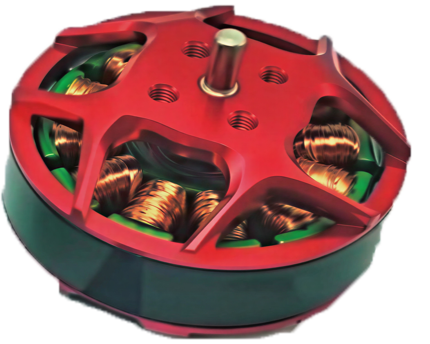
In the propulsion system of fixed-wing drone, although the motor does not directly generate lift, it exerts a decisive influence on flight endurance, payload capacity, and flight stability. Compared to multi-rotors, fixed-wing platforms place greater emphasis on continuous operating efficiency and long-term reliability, making the selection process highly scenario-dependent.
1. Introduction to Fixed-Wing Drone Motors
In a fixed-wing drone, the motor is the power source of the propulsion system. By driving the propeller to generate forward thrust, it enables the aircraft to maintain the required airspeed. The motor itself is not directly involved in lift generation; instead, it provides the stable airflow conditions necessary for the wings to produce lift. Therefore, the evaluation of a fixed-wing motor centers not on its maximum thrust, but on its efficiency performance under common operating conditions. Under the same electrical energy conditions, the ability to maintain a stable cruise with lower power consumption is the key factor affecting flight endurance and mission completion.
2. Typical Operating Modes of Fixed-Wing Motors
Fixed-wing drones have different power demands across various flight stages. The takeoff and climb phases require high power output to establish airspeed or gain altitude. Once in the cruise phase, the motor typically runs continuously under relatively stable RPM and load conditions. Since cruising accounts for the majority of flight time, the motor must maintain stable output and control temperature rise over long periods. If a motor’s efficiency is low within its common load range, even if its peak parameters are high, it may lead to higher energy consumption and thermal accumulation during long flights.
3. Core Differences Between Fixed-Wing and Multi-Rotor Motors
The differences in flight principles between fixed-wing and multi-rotor drones directly affect the motor's operating mode. Multi-rotor motors simultaneously handle lift and attitude control; their loads change frequently, requiring high response speeds and instantaneous thrust. In contrast, fixed-wing motors primarily maintain constant propulsion force during stable flight, with relatively smooth load changes.
Therefore, fixed-wing motors emphasize continuous efficiency and operational stability, while multi-rotor motors focus on thrust density and dynamic response. This difference is also reflected in propeller matching: fixed-wing aircraft often use larger-diameter, lower-RPM propellers to improve efficiency, whereas multi-rotors typically use smaller-diameter, high-RPM configurations.
|
Comparison Aspect |
Fixed Wing Drone Motor |
Multirotor Drone Motor |
|
Primary Function |
Provides continuous, stable forward thrust to maintain airspeed for lift generation by the wing |
Directly generates lift and contributes to attitude control |
|
Direct Lift Generation |
Does not directly generate lift; lift is produced mainly by the wing |
Directly generates lift |
|
Typical Operating State |
Long-duration operation at relatively stable speed and load |
Frequent speed changes with highly dynamic load conditions |
|
Load Variation Characteristics |
Smooth and gradual load changes during cruise |
Rapid and frequent load fluctuations due to maneuvering and stabilization |
|
Design Priority |
Continuous efficiency, thermal stability, and long-term reliability |
Thrust density, dynamic response, and peak power capability |
|
Importance of Peak Power |
Lower; efficiency in the typical operating range is more critical |
Higher; peak thrust directly affects maneuverability |
|
Typical KV Characteristics |
Lower KV, suited for high-voltage, low-RPM operation |
Higher KV, suited for lower-voltage, high-RPM operation |
|
Typical Propeller Setup |
Large-diameter, low-RPM, efficiency-oriented propellers (often folding props) |
Small-diameter, high-RPM, response-oriented propellers |
|
Motor Runtime Characteristics |
Motors run continuously for most of the flight |
Motors operate under constant throttle and RPM adjustments |
|
Thermal Stress Source |
Heat accumulation from long-term continuous operation |
High current spikes and short-duration high-power loads |
|
System Matching Sensitivity |
Highly sensitive to voltage, propeller diameter, and pitch matching |
More sensitive to ESC response and motor speed dynamics |
|
Typical Applications |
Long-endurance fixed wing UAVs, heavy-payload platforms, gliders |
FPV drones, aerial photography multirotors, industrial multirotors |
4. Why Do Fixed-Wing Drone Have Higher Requirements for Motors?
Although fixed-wing motors are rarely at extreme load limits, their characteristic of long-term continuous operation places higher demands on efficiency, heat dissipation, and reliability. Cruise efficiency directly affects endurance, and the heat accumulation from continuous running tests the motor's structural and material quality over long periods.
Furthermore, fixed-wing propulsion systems are particularly sensitive to matching relationships. The motor KV, voltage system, propeller size and pitch, ESC capability, and battery characteristics all collectively influence the motor's actual working state. If mismatched, a motor may operate in a low-efficiency or high-temperature range for long periods, even under a seemingly low load. Therefore, fixed-wing motor selection emphasizes overall system compatibility and long-term performance rather than the limit of a single parameter.